
Solar Panel Tariffs
NimbleFins explains the two unusual energy tariffs you might come across if you have solar panels—SEG export tariffs (earning you money when you sell excess solar-generated power to the grid) and Time of Use tariffs (to charge a home battery, which is often a part of a solar PV system, at cheaper rates from the grid during the night). We also explain how a solar panel battery makes a difference in how you can benefit from these tariffs.
SEG Solar Export Tariffs
If you have solar and you're out of the house on a really sunny day, barely using any of your solar-generated energy as it's produced, what do you do with all that excess energy? You can:
- Let it go to waste
- Store it in a home battery
- Sell it back to the grid via a SEG tariff
The Smart Export Guarantee (SEG) enables homes or businesses with renewable energy (primarily solar PV panels) to get paid for exporting excess renewable electricity back to the grid. A SEG tariff essentially means that you can earn money on your excess solar power.
The government-backed SEG dates back to 1 January 2020. If you're a home owner with solar, you're a 'SEG Generator'. SEG Licensees (energy suppliers) pay SEG Generators for low-carbon electricity which they export back to the National Grid—providing certain criteria are met.
What are SEG requirements?
Not everyone with renewable energy generation can apply for a SEG tariff. To sign up for the Smart Export Guarantee in 2026, you'll need to:
- Have a renewable electricity generating system that meets the SEG eligibility eligibility.
- Have a smart meter capable of providing half-hourly export readings.
- Show that your installation and installer are certified through the microgeneration certification scheme (MCS) or equivalent.
- NOT be receiving export payments under the old Feed-in Tariff (FiT) scheme.
- Be located in Great Britain with a capacity <= 5MW.
Is a SEG tariff worth it?
In our opinion, if you have solar WITH a home battery, you're often better off storing excess solar power in the battery for self consumption (i.e. to use later in your own home) rather than sell it back to the grid on a SEG tariff. However, in 2026, the importance of shopping around is highlighted by market data, which show that while the standard Octopus SEG tariff pays 4.1p/kWh, other suppliers now offer more competitive 'premium' export rates.
For instance, E.On Next currently offers an export rate of 16.5p/kWh (provided they also supply your energy), and British Gas has increased their 'Export and Earn Plus' rate to 15p/kWh for their energy customers. Even with these higher rates, selling is still lower than the 27.67p/kWh cost of buying electricity under the Q2 2026 Energy Price Cap.
On the other hand, if you have solar WITHOUT a home battery, then having a SEG tariff is essential. Without it, you are giving away excess energy for free. While 15p–16.5p is better than 4.1p, any SEG payment is better than nothing!
Time of Use Tariffs
A Time of Use (TOU) tariff has cheaper rates at certain times (usually at night) and more expensive rates at peak times (usually 4pm–7pm).
Energy companies use TOU tariffs to encourage consumers to use electricity when nationwide demand is lower, helping to balance the National Grid and avoid brownouts.
- CHEAPER in the middle of the night
- MORE EXPENSIVE in the late afternoon/early evening
Time of Use tariff example
A typical 2026 Time of Use tariff (like Octopus Flux or Agile) might have a standard rate of 29.7p/kWh during the day, but spike 40% higher during the evening peak and drop 40% lower in the middle of the night (e.g., 2am–5am).
This is a perfect example of a typical Time of Use tariff—regular rates most of the day, with cheaper rates during low-demand nighttime hours and higher rates during high-demand early evening hours.
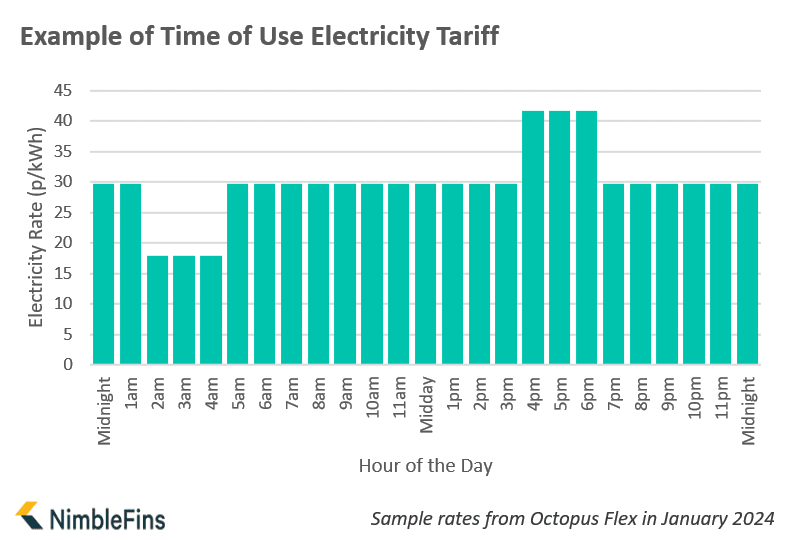
Why is 4pm through 7pm a peak time for electricity consumption? It's when many households are getting home from work or school, and most households are starting to warm up and light their homes and cook dinner.
How a Time of Use tariff relates to solar panels
It's quite common to include a home battery along with a solar panel installation. This allow you to:
- Charge from Solar: Excess solar-generated power that is not immediately used by the home can be directed to charge the home battery.
- Charge from the Grid: The home battery can be charged from the grid; ideally, this is done during the night on a cheaper Time of Use tariff, when you'll typically pay at least 40% less for grid energy.
So, if you have a Time of Use tariff you set the home battery in your solar panel system to charge from the grid at night when prices are cheapest, then use this electricity during peak times of the day when prices are higher.
Other ways to use a TOU tariff
In addition to charging a solar PV system home battery, there are also some other uses for a Time of Use tariff:
- Charging an EV on TOU tariff: You can also charge an EV on the cheapest nighttime TOU rates, which can bring the cost down to as little as 2.4p per mile (compare this to the ~15p per mile fuel cost of a petrol car).
- Use high-energy appliances at night. Use appliances such as a washing machine, tumble dryer or dishwasher at night when there's a cheap TOU rate to save money on your energy bills. These high-energy appliances can cost quite a lot to run on a standard tariff.
- Use electric heating. Heating contributes to a large chunk of energy bills, especially in winter. While gas heating is typically cheaper to run than electric heating, you may find that a TOU tariff means you can save money by using electric heating, if you time your heating to come on during the hours when rates are cheapest.
Solar panel costs
In 2026, the importance of budgeting for green energy is highlighted by predictions of installation data, which are expected to show that the cost of solar panels has reached around £2,100 per kW of power. Consequently, a typical 4kW installation is now expected to cost around £8,400, reflecting modest rises in qualified electrical labour and high-efficiency component costs since 2024.